Ilgar Ibrahimoglu
A Muslim holy day – Eid al-Adha or Gurban Bayram as it's known in Azeri (Festival of the Sacrifice) – is coming. What does this holiday mean for you?
Currently we are living in the holy month of Dul al-Hijjah and the 10th day of this month is called Gurban or Sacrifice. People perform the hajj and the culmination of the pilgrimage to Mecca is the Gurban Holiday which includes sacrifices. People who do not go on pilgrimage should also make sacrifices at home. The philosophy of this holiday is significant. First of all, it gives a feeling of self-sacrifice for the sake of high ideals and promotes a culture of sharing with others and charity. In fact, this is a kind of solidarity, creating an opportunity for people and families to gather together, visit each other, remember those who have gone. This holiday has many elements. But the most important is that it brings peace. Even the Soviet powers could not remove this holiday from people’s lives and our people marked this holiday in Soviet times too.
Does the celebration of Gurban Bayram in Azerbaijan meet the canons of this holiday?
Unfortunately, the Gurban Holiday in Azerbaijan is usually perceived as a ritual. People know its external components but they do not know much about its philosophical essence. There is not enough educational work on this. Television does not fulfil its function of education and information here. Much should be done for people to understand that this holiday does not consist of only the ritual sacrifice of sheep. The main philosophy of this holiday is to give meat to the poor. Moreover, this is a holiday that teaches compassion for the poor. Therefore, I think this holiday tends to be superficial in Azerbaijan. Unfortunately, some traders make use of the chance to raise meat prices. I was recently in Brussels and I wondered how Muslims there prepare for the holiday and I was astonished at the fact that there are posters in almost all shops and cafes belonging to Muslims that remind us that this holiday is a good chance to help the poor. I think if this happens in the centre of Europe, it should also take place in a Muslim state such as ours. And I am sure that education is needed.
Is your community going to hold any events during this holiday?
We hold holiday concerts every year along with namaz (prayers) and other ritual elements of the holiday and we create an opportunity for fellowship. What's most important is that this holiday brings much joy and many positive features to the people. People share positive emotions and problems which is important for all societies including ours.
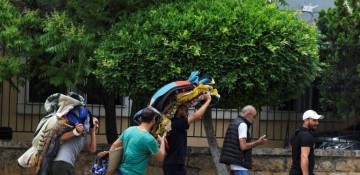
The main feature of this holiday is the mass slaughter of sheep on the roadside in not very hygienic conditions. Do you think the ritual could be held in a more civilized way in order not to scare passersby?
I think the situation arises as people do not have the right conditions. We should create good opportunities for people, give them a real alternative not to do this. Certainly, when sheep are slaughtered at the roadside, the whole holiday is associated with bloodshed. Unfortunately, this does not give rise to the best, most positive feelings. Therefore, I think work should be started to create the right conditions for people and, most importantly, to show not only this ritual to the people. The Gurban Holiday is more than this. Therefore, I think the whole of society is responsible. Television should play the role of an educator. Unfortunately, television is currently busy with other issues at present and there is no other way to teach values to the people. Even in Soviet times the holiday was celebrated better and more sincerely. Now it has become a show, a moment that has nothing to do with the philosophy of the holiday. But I think the situation will improve.
Is your community planning any measures to inform people about the real essence of this holiday?
We do it as much as we can, including on our websites and via social networks. But, unfortunately, the television channels recall the holiday only on the day of the holiday. And even when they do mention it, they do it in a narrow way. Therefore, today it is very difficult to inform the public, while people that read newspapers and use the Internet maintain cultural values owing to their education. But most of the public watches television and this is a great problem.
Leyla Tagiyeva
News.Az
Commentary